
1. Introduction
Pain is not just a physical signal—it is shaped by autonomic load, emotional stress, muscle tension, posture, cognitive focus, and environmental demands. In high-stress environments—ICUs, wildfire camps, conflict zones, and high-pressure performance settings—people often find that pain feels louder, harder to ignore, and more difficult to regulate.
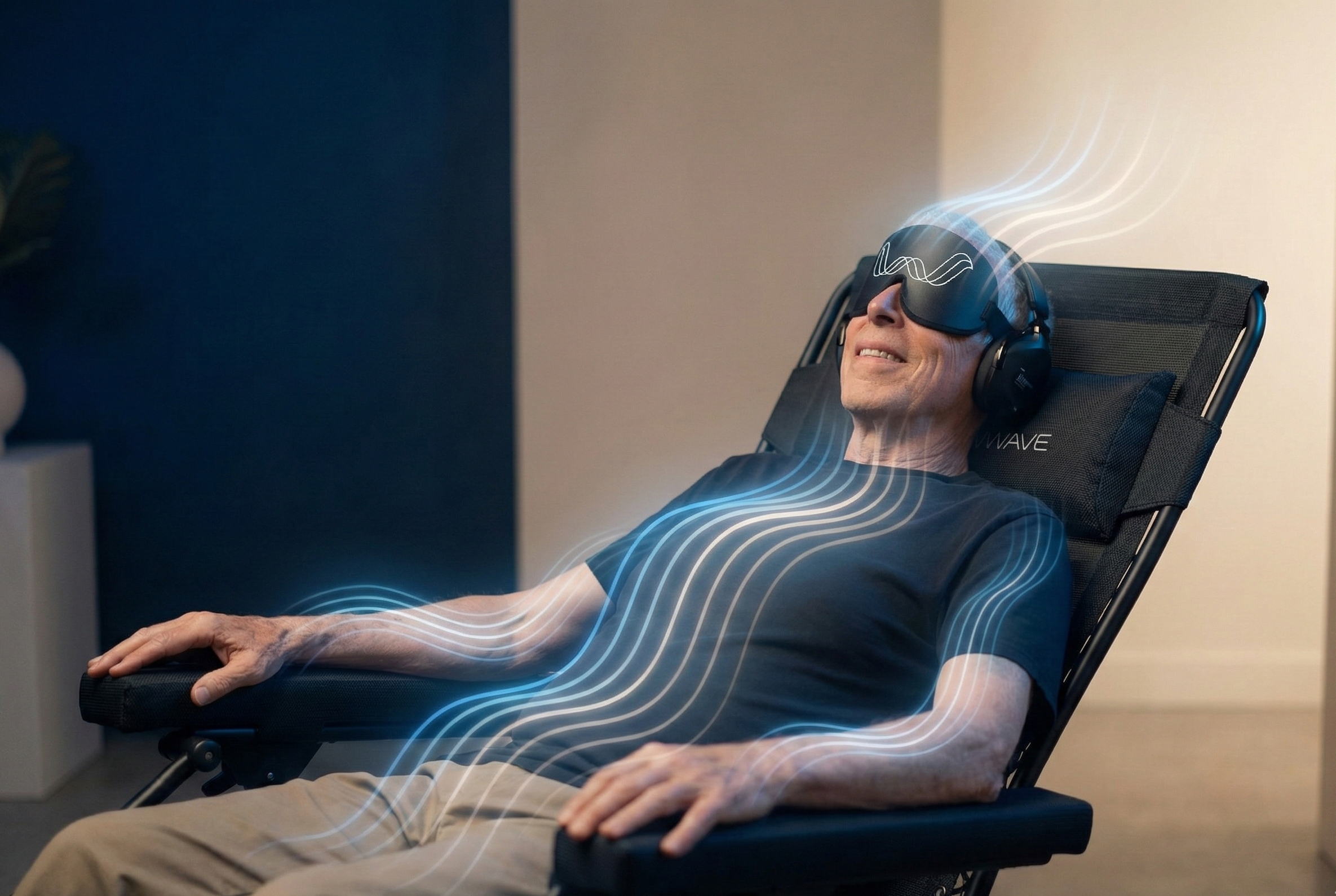
Shiftwave is a general wellness technology designed to support the body’s natural ability to relax, unwind, and modulate discomfort. Through patterned full-body vibration, breath-paced tactile cues, sensory immersion, and zero-gravity recline, many users report that their bodies settle into calmer states where pain feels easier to manage.
Shiftwave does not diagnose, treat, or prevent medical pain conditions. Instead, it supports state changes—emotional, physical, and autonomic—that many users describe as helping them feel less pain, less tension, and more comfort.
This paper summarizes the scientific rationale behind these effects and reviews real-world observational data showing consistent self-reported reductions in perceived pain after brief Shiftwave sessions.
2. Scientific Basis for Supporting Pain Relief
2.1 Breathwork and Pain
A strong body of research shows that slow, controlled breathing can meaningfully change how pain is experienced:
-
Slow breathing reduces pain intensity and autonomic arousal (Nilsen et al., 2020; Busch et al., 2012).
-
Paced respiration increases HRV and vagal activation—mechanisms associated with reduced pain sensitivity (Lehrer & Gevirtz, 2014).
-
Controlled breathing reduces the emotional “threat” component of pain (Zautra et al., 2010).
Shiftwave incorporates this evidence by using vibration patterns synchronized to inhale/exhale rhythms, giving users a clear physical cue that makes breath regulation easier—especially during stressful or fatigued states.
2.2 Whole-Body Vibration and Pain
Whole-body vibration (WBV) studies show that mechanical stimulation in the 20–45 Hz range can:
-
Support reductions in musculoskeletal pain perception (Liao et al., 2018; Sitjà-Rabert et al., 2012)
-
Improve proprioception and sensory feedback (Ritzmann et al., 2014)
-
Reduce muscle tension and support circulation (Kerschan-Schindl et al., 2001)
-
Compete with pain signals via mechanoreceptor activation (Lundeberg et al., 1984)
Shiftwave differs from traditional WBV platforms by offering:
-
Reclined, comfortable posture
-
Patterned, wave-like mechanical pulses
-
Breath-synchronized vibration
-
Multimodal sensory integration
While Shiftwave is not claiming identical outcomes to WBV exercise systems, WBV research provides strong biological plausibility for why mechanical stimulation may influence perceived pain.
3. How Shiftwave Helps People Feel Less Pain
Users frequently report that Shiftwave helps them enter states where pain feels less intense, less distracting, or easier to tolerate. Four mechanisms likely contribute to these subjective shifts:
1. Mechanoreceptor Activation
Deep mechanical vibration provides competing sensory input that may dampen nociceptive signaling—consistent with gate-control principles.
2. Breath-Paced Relaxation
Vibrotactile breath cues support autonomic down-regulation, often associated with decreased pain sensitivity.
3. Postural Unloading
Zero-gravity recline decreases muscle activation and spinal compression—reducing tension that commonly amplifies pain.
4. Sensory Immersion
Structured audio and tactile patterns reduce cognitive fixation on discomfort, shifting attention away from pain.
Shiftwave does not treat pain at the source. Instead, it helps shift the user into a state where pain feels more manageable, aligning with the natural physiology of pain modulation.
4. Field Observations: Self-Reported Reductions in Perceived Pain
Across humanitarian and high-stress environments, individuals consistently report feeling less pain after 10–20 minutes in Shiftwave. These findings are subjective and self-reported, but remarkably consistent.
COVID ICU Staff (N = 24)
-
37% reported feeling less pain
-
54% reported their pain felt completely gone during the session
Wildfire Responders (N = 35)
-
26% reported complete relief from pain during the session
Ukrainian Evacuation Drivers (N = 23)
-
66% reported reduced pain
-
43% reported complete relief
Combat Medical Personnel (N = 25)
-
58% reported reduced pain
Rehabilitation Hospitals – Ukrainian Warfighters (N = 59)
-
32% reduction in self-reported pain
-
12% reported full relief
These are observational, real-world findings—not clinical claims—but they show a meaningful pattern:
People consistently report feeling less pain after using Shiftwave.
5. Controlled Study: 210-Person Evaluation of Self-Reported Pain
A structured evaluation at Lisova Polyana Centre for Mental Health and Rehabilitation used the Wong-Baker Pain Scale to measure perceived pain before and after a single Shiftwave session.
Key results (Rouse & Serdiuk, 2025):
-
37.6% decrease in self-reported pain (3.22 → 2.01)
-
Large effect size: d = 0.76
-
Participants with baseline pain reported 38.7% reduction (d = 0.93)
-
High-burden participants (pain + anxiety) reported 38.7% reduction and 74.7% positive response
These results cannot be interpreted as treatment effects—but they strongly reinforce that users commonly experience a meaningful decrease in perceived pain after Shiftwave.
6. Conclusion
Pain is influenced by autonomic state, emotional load, sensory processing, muscle tension, and cognitive attention. Research shows that breathwork, vibration, and sensory modulation can all shape the experience of pain.
Shiftwave brings these evidence-supported modalities together into an effortless, enjoyable session that helps people:
-
feel less pain
-
relax physically
-
unwind tension
-
shift into a more comfortable state
Shiftwave makes no medical claims. It is a general wellness technology that supports the body’s natural ability to settle, relax, and modulate discomfort—helping people feel less pain and more at ease, often within minutes.
References
Breathwork Research
Busch, V., Magerl, W., Kern, U., Haas, J., Hajak, G., & Eichhammer, P. (2012). The effect of deep and slow breathing on pain perception, autonomic activity, and mood processing—An experimental study. Pain Medicine, 13(2), 215–228.
Lehrer, P., & Gevirtz, R. (2014). Heart rate variability biofeedback: How and why it works. Frontiers in Psychology, 5, 756.
Nilsen, K. B., Sand, T., & Westgaard, R. H. (2020). The effect of breathing techniques on pain perception: A systematic review. Journal of Pain Research, 13, 3297–3310.
Zautra, A. J., Fasman, R., Davis, M. C., & Craig, A. D. (2010). The effects of slow breathing on affective responses to pain stimuli. Pain, 149(1), 12–18.
Whole-Body Vibration Research
Kerschan-Schindl, K., Grampp, S., Henk, C., Resch, H., Preisinger, E., Fialka-Moser, V., & Imhof, H. (2001). Whole-body vibration exercise leads to alterations in muscle blood volume. Clinical Physiology, 21(3), 377–382.
Liao, L. R., Ng, G. Y. F., Jones, A. Y. M., & Pang, M. Y. C. (2018). Whole-body vibration and pain perception in chronic musculoskeletal conditions: A systematic review. Archives of Physical Medicine and Rehabilitation, 99(6), 1213–1225.
Lundeberg, T., Nordemar, R., & Ottoson, D. (1984). Pain-alleviating effect of vibratory stimulation. Pain, 20(1), 25–44.
Ritzmann, R., Kramer, A., Gruber, M., Gollhofer, A., & Taube, W. (2014). EMG activity during whole-body vibration: Motion artifacts or stretch reflexes? European Journal of Applied Physiology, 104(4), 423–433.
Sitjà-Rabert, M., Rigau, D., Fort, R., et al. (2012). Whole-body vibration for older adults with chronic pain: A systematic review. Journal of Alternative and Complementary Medicine, 18(11), 1010–1020.
Shiftwave Internal Sources
Shiftwave humanitarian field data — pain and anxiety outcomes.
Rouse, J., & Serdiuk, K. (2025). Impact of Shiftwave Technology on Pain and Anxiety Scores.




How Shiftwave Supports Stress Reduction
How Shiftwave Supports Performance, Readiness & Cognitive Clarity