
1. Introduction
Sleep difficulties often stem from physiological hyperarousal—elevated sympathetic tone, muscle tension, rumination, and disrupted respiratory rhythm. When the nervous system cannot downshift, the body struggles to enter the parasympathetic dominance required for healthy sleep onset and continuity.
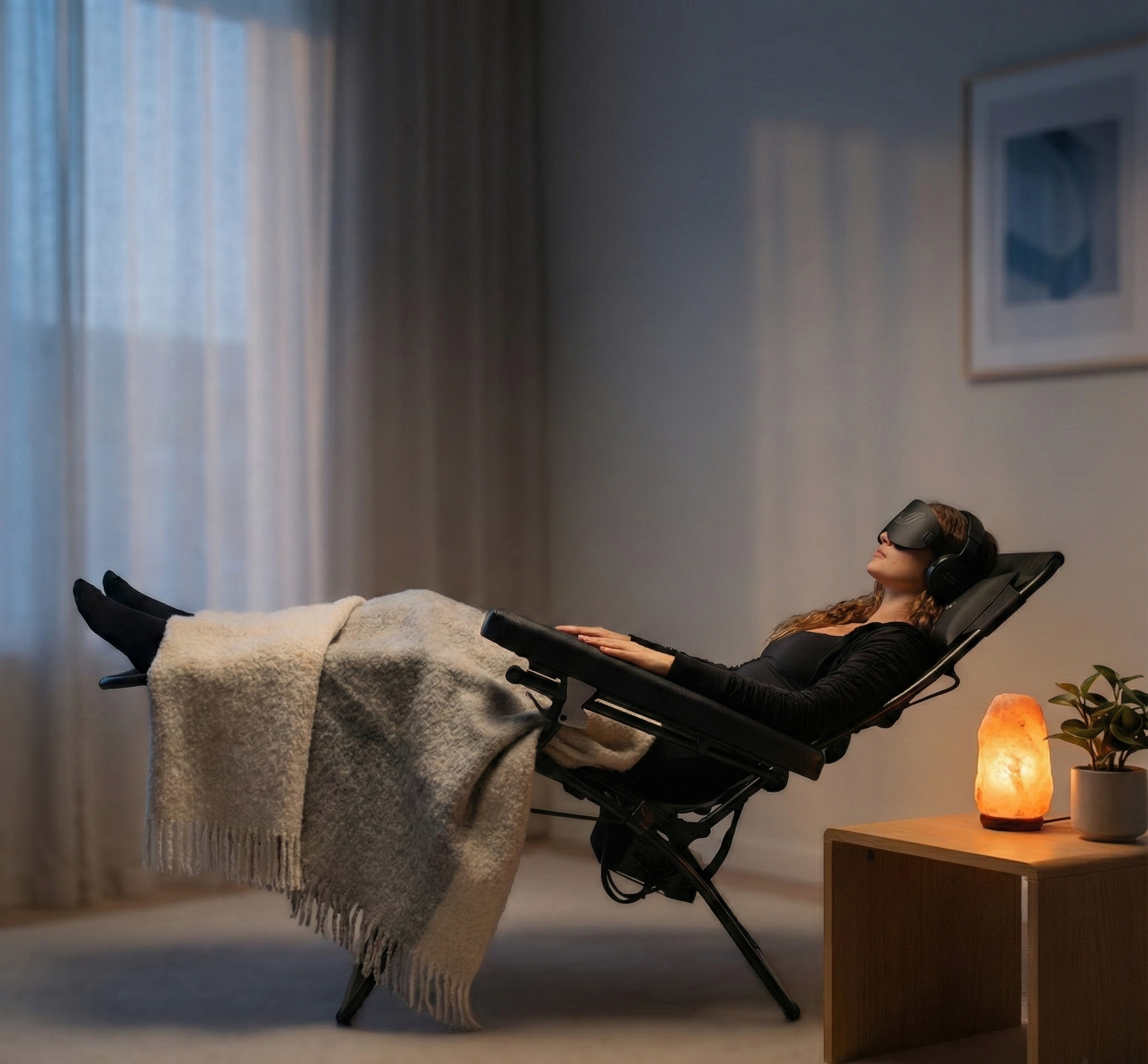
Shiftwave is a general wellness technology that uses patterned full-body vibration, breath-paced tactile cues, sensory immersion, and zero-gravity posture to help individuals access calmer, more restful physiological states. It does not diagnose or treat sleep disorders; instead, it supports relaxation and sleep readiness.
This paper outlines the scientific basis for these modalities and presents real-world evidence showing that Shiftwave sessions help users feel more relaxed, less tense, and better prepared for rest.
2. Scientific Basis for Sleep Support
Sleep readiness depends on autonomic balance, breath rhythm, emotional state, sensory modulation, and muscular tension. Each of Shiftwave’s modalities has established research support for promoting conditions conducive to sleep.
2.1 Breathwork and Sleep
Controlled breathing is one of the most studied non-pharmacological interventions for pre-sleep relaxation.
Evidence shows that slow, diaphragmatic breathing:
-
Reduces sympathetic arousal (Tsai et al., 2015)
-
Improves HRV and vagal activation (Lehrer & Gevirtz, 2014)
-
Lowers pre-sleep rumination (Werner et al., 2020)
-
Reduces cortisol and supports relaxation (Ma et al., 2017)
Shiftwave uses tactile breath entrainment, guiding users into slow respiration through vibration patterns synchronized with inhale and exhale.
2.2 Vibration-Based Relaxation and Sleep Readiness
Mechanical vibration influences autonomic and muscular systems relevant to sleep:
-
Low-frequency mechanical stimulation promotes relaxation (Matsumoto et al., 2011)
-
Vibration reduces anxiety and muscle tension (Lundeberg et al., 1984)
-
Rhythmic vibration paired with audio increases pre-sleep calm (Horowitz et al., 2018)
Shiftwave’s reclined, patterned vibration differs from traditional WBV, but leverages the same mechanoreceptor pathways associated with calming and readiness for rest.
2.3 Sensory Immersion and Cognitive Quieting
Multisensory relaxation reduces pre-sleep cognitive load:
-
Immersive soundscapes reduce stress physiology (Annerstedt et al., 2013)
-
Sensory focus decreases intrusive thought patterns (Brewer et al., 2011)
-
Calming audio increases alpha activity linked to pre-sleep relaxation (Ishimatsu et al., 2021)
Shiftwave combines sound + vibration + posture into a coherent sensory experience that helps the nervous system downshift.
2.4 Postural Support and Muscle Unloading
Zero-gravity positioning:
-
Reduces muscular load and spinal tension (Cutler et al., 2004)
-
Improves comfort and pre-sleep relaxation (Chang et al., 2018)
Shiftwave uses this posture to facilitate deep physical ease—an essential precursor to sleep onset.
3. How Shiftwave Supports Sleep Preparation
Shiftwave promotes sleep readiness through four pathways:
-
Autonomic Down-Regulation
Breath-synchronized vibration encourages vagal activation. -
Reduction of Muscle Tension
Zero-gravity posture minimizes physical strain. -
Lower Cognitive Arousal
Sensory immersion reduces rumination and mental noise. -
Somatosensory Grounding
Deep vibration provides predictable rhythmic input that fosters calm.
It does not treat insomnia or clinical sleep disorders.
4. Observational Evidence From Field Deployments
While not sleep-specific studies, field deployments show reliable reductions in tension, stress, and anxiety—factors strongly correlated with improved sleep readiness.
LA Wildfire Responders (N = 35)
-
55% reported complete stress elimination
ICU Clinicians (N = 24)
-
82% reported anxiety reduction
Ukrainian Evacuation Drivers (N = 23)
-
68.1% experienced complete anxiety relief
Rehab Hospitals – Ukrainian Warfighters (N = 59)
-
48% reduction in anxiety
In each setting, users frequently reported improved relaxation and a greater sense of calm—key precursors to healthy sleep.
5. Controlled Study: Anxiety Reduction in 210 Participants
A structured evaluation using the 5-item State Anxiety Inventory demonstrated:
-
22.1% reduction in state anxiety
-
Large effect size (d = 0.89)
-
25.4% reduction among high-anxiety participants
Since nighttime hyperarousal is one of the strongest predictors of poor sleep, these results support Shiftwave’s use as a pre-sleep relaxation tool.
6. Synthetic Sleep: A Next-Day Recovery Protocol
Even with the best intentions, people sometimes face nights of insufficient or fragmented sleep. Synthetic Sleep is Shiftwave’s next-day restorative protocol designed to help users recover a sense of clarity and balance.
It does not replace sleep or replicate the full biology of natural sleep. Instead, it leverages cues associated with deep restorative rest.
6.1 Purpose and Rationale
Synthetic Sleep is used:
-
the next morning after poor or inadequate sleep,
-
during high-demand operational periods,
-
or between shifts when users need rapid restoration.
It aims to help the nervous system access deep-rest physiological patterns, improving the user’s perceived readiness for the day.
6.2 Preliminary Laboratory Findings
Early closed-loop BioDrive® studies suggest that Synthetic Sleep supports:
1. Increased cerebrospinal fluid (CSF) dynamics
Preliminary findings indicate improved CSF fluctuation patterns.
This aligns with research showing that natural deep sleep dramatically increases CSF flow, enhancing metabolic clearance (Xie et al., 2013; Fultz et al., 2019).
These observations are early and not yet clinically validated but provide scientific grounding for further study.
2. Increased slow-wave brain activity
Pilot EEG recordings show increases in delta-band (0.5–4 Hz) activity, the defining electrical signature of slow-wave sleep.
Slow-wave activity is strongly associated with:
-
restoration,
-
memory consolidation,
-
and physiological recovery (Tononi & Cirelli, 2014).
Synthetic Sleep does not claim to replicate N3 sleep but appears to help users enter slow-wave–like restorative states.
6.3 Anecdotal User Reports
Across athletes, clinicians, operators, and humanitarian staff, users report that Synthetic Sleep:
-
“restores” energy after poor sleep
-
improves clarity and focus
-
reduces grogginess
-
helps them feel “reset” and emotionally balanced
These subjective reports mirror the physiological patterns observed in early lab data.
6.4 Mechanistic Rationale
Synthetic Sleep integrates four evidence-backed mechanisms:
-
Low-frequency vibration → mechanoreceptor-driven calm (Lundeberg et al., 1984)
-
Delta-range entrainment cues → slow-wave–aligned rhythmic stimulation
-
Zero-gravity recline → muscular tension reduction (Chang et al., 2018)
-
Slow respiratory pacing → vagal activation (Lehrer & Gevirtz, 2014)
The goal is to create conditions that approximate the restorative aspects of deep rest, helping users feel more recovered despite limited sleep.
6.5 Compliance Positioning
Synthetic Sleep should be clearly positioned as:
-
a general wellness recovery protocol,
-
a tool that supports feelings of restoration,
-
not a replacement for sleep or a treatment for sleep pathology.
7. Conclusion
Breathwork, vibration, sensory immersion, and postural unloading all have strong scientific support for facilitating the calm physiological states required for sleep. Shiftwave integrates these modalities into a single, effortless experience that helps users relax, unwind, and prepare for rest.
The Synthetic Sleep protocol extends this model by helping users feel more restored the next day, especially after poor or insufficient sleep—leveraging preliminary data showing CSF fluctuations and slow-wave–related activity.
Shiftwave makes no medical sleep claims. It is a general wellness technology designed to support the body’s natural capacity for relaxation and recovery.
References
Breathwork & Sleep
Lehrer, P., & Gevirtz, R. (2014). Heart rate variability biofeedback. Frontiers in Psychology, 5, 756.
Ma, X., et al. (2017). Diaphragmatic breathing and stress reduction. Frontiers in Psychology, 8, 874.
Tsai, H. J., et al. (2015). Paced breathing and insomnia physiology. Psychophysiology, 52(3), 388–396.
Werner, G. G., et al. (2020). Slow breathing & pre-sleep calm. Int. J. Psychophysiology, 158, 1–10.
Zaccaro, A., et al. (2018). Psychophysiological effects of breathing techniques. Frontiers in Human Neuroscience, 12, 353.
Vibration & Relaxation
Horowitz, S. S., et al. (2018). Rhythmic sensory stimulation and relaxation. Neurobiol. Rev., 95, 67–81.
Kerschan-Schindl, K., et al. (2001). WBV and muscle blood flow. Clinical Physiology, 21, 377–382.
Lundeberg, T., et al. (1984). Anxiety-reducing effects of vibratory stimulation. Pain, 20(1), 25–44.
Matsumoto, T., et al. (2011). Relaxation response to low-frequency vibration. JPTS, 23(2), 219–224.
Sensory Immersion & Rest
Annerstedt, M., et al. (2013). Nature soundscapes & stress recovery. Physiology & Behavior, 118, 240–250.
Brewer, J. A., et al. (2011). Meditation & DMN modulation. PNAS, 108(50), 20254–20259.
Ishimatsu, T., et al. (2021). Acoustic entrainment & pre-sleep relaxation. Sleep Medicine, 83, 108–116.
Posture
Chang, C. M., et al. (2018). Zero-gravity posture & comfort. Applied Ergonomics, 67, 139–147.
Cutler, R. B., et al. (2004). Reclined positioning & muscular load. J. Bodywork & Movement Therapies, 8, 23–30.
CSF Flow & Slow Wave Sleep
Fultz, N. E., et al. (2019). Coupled electrophysiological and CSF oscillations in human sleep. Science, 366(6465), 628–631.
Xie, L., et al. (2013). Sleep drives metabolite clearance via CSF flow. Science, 342(6156), 373–377.
Tononi, G., & Cirelli, C. (2014). Sleep and synaptic homeostasis, slow waves, and restoration. Neuron, 81(1), 12–34.
Shiftwave Internal Sources
Shiftwave Humanitarian Field Data — stress/anxiety outcomes.
Rouse, J., & Serdiuk, K. (2025). Impact of Shiftwave Technology on Pain and Anxiety Scores.



How Shiftwave Supports Performance, Readiness & Cognitive Clarity
Breathwork-Based Nervous System Regulation